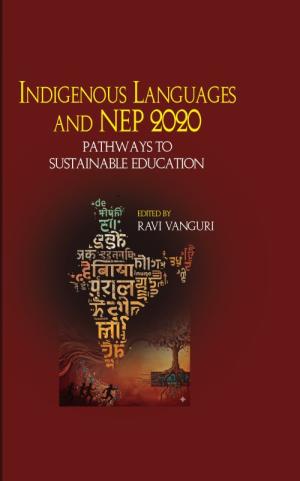

PATHWAYS TO SUSTAINABLE EDUCATION
pp xiii+209
Language is crucial to cultural identity, as it shapes how people connect and express themselves. The rapid growth of technology and digital communication has led to the decline of many Indigenous languages, threatening the cultural knowledge and traditions they carry. The National Education Policy 2020 also seeks to address this issue by emphasizing mother tongue-based education to preserve and promote Indigenous languages. This book discussed the challenges and opportunities of sustaining Indigenous languages, with a focus on their role in education, culture, and society. It also examines government initiatives, parental perspectives, and strategies for language preservation, ensuring that Indigenous languages continue to thrive. The ideas and perspectives of academicians and researchers in this volume may be useful to students, teaching faculty, and policy makers who work in this area.
Dr. Ravi Vanguri is a Senior Assistant Professor in the Central University of Jammu. Formerly, he served in Regional Institute of Education, (NCERT) Bhopal, Madhya Pradesh. He has more than ten years of teaching experience and guides Ph.D. students. He has to his credit many published and presented papers in international and national conferences. He is also an active member of the Research Advisory Committee (RAC) at various departments of the Central University of Jammu.
Foreword
Acknowledgement
Part I
Role of Indigenous Languages in the Growth and Development of Bharat
1. Digital Revitalization: Leveraging AI and EdTech for the Preservation and Promotion of Indigenous Languages in India
Swamy Bairi
2. Revitalizing the Irula Language: A Critical Study of Efforts in Indigenous Language Protection/ P. Arul Nehru/ 13
3. Global Visibility of Indigenous Languages through Academic Centres/ Bonala Kondal/ 23
4. Promoting Indian Languages: Influencing India’s Education and Global Presence/ Chittibabu Putcha, Sujata Chhatri/ 37
5. Impact of Globalization on Indigenous Languages: Threats and Opportunities/ Ranjit Kumar Elamadurthi/ 45
6. Cultural Identity and Linguistic Diversity: Role of Native Languages in Education in the light of NEP-2020
Ravi Vanguri, Rumeeta Sharma/ 55
7. Indigenous Languages and NEP 2020: Pathways to Bharat’s Sustainable Growth and Education
Nishta Rana, Sonika Devi, Vishali Sharma/ 67
8. Digital Interventions for the Preservation and Promotion of Indigenous Languages of India
Mohan Galgotra, Sheetal Khajuria, Sonika Devi/ 77
9. Youth and Indigenous Languages: Role in Political Education/ Prof. Asit K. Mantry, Sanjay Kumar, Akhil Wazir/ 88
10. Preserving and Revitalizing Heritage through Education: Integrating Dogri in Multilingual School Curricula/ Yad Ram, Rubina Jamwal/ 95
Part II
Opportunities, Challenges and Interventions in Promoting Indigenous Languages
11. Promoting Indigenous Indian Languages vis-a-vis NEP 2020: Translational Intervention/ M.A. Afzal Farooq/ 110
12. Patronage of Dogri Language by Dogra Rulers: A Historical Analysis of Language, Culture, and Power/ Puneet Sharma/ 122
13. Contemporary Military Strategy and Defence Education: Role of Indigenous Indian Languages/ R. Sudhakar, Abhigya Langeh/ 128
14. Safeguarding Indigenous Languages: Challenges, Preservation and Revitalization Strategies/ Sunita Devi, Bisat Tariq/ 137
15. Interventions of Technology in Promoting Indigenous Knowledge/ Deepa Sikand Kauts, Rajbir Kaur/ 143
16. Tech Meets Tradition: Innovating for Indigenous Language Revival/ Vinod Kumar Kanvaria, Bhavna Rajpoot/148
Part III
Multilingual Education and Role of Stakeholders in Language Inclusivity
17. Reviving Indigenous Languages through Traditional Games: A Multidisciplinary Pedagogical Approach/ Vandana Talegaonkar, Minaxi Bhagwat/ 155
18. Translanguaging in Multilingual Education: A Pathway to Revitalization of Indigenous Language
Ravi Vanguri, Rajni Kumari, Minakshi Thapa
19. Impact of Multilingual Education on Fostering Inclusivity in Multicultural Societies
M S Kariyappa, Poonam Aggarwal/ 168
20. Restoring and Protecting Indigenous Languages through Legal Framework in India
A Step towards Sustainability/ Avantika Mahajan/ 175
21. Bridging the Learning Gaps: Supporting Children with Learning Disabilities through Multilingualism in Classrooms/ Kiran, Monika/ 181
22. Creating Inclusive Learning Environments through Multilingual Education
J.N. Baliya, Vivek Kumar, Mili Rani/ 188
23. Multilingualism as a Path to Inclusivity/ Arshi Acharjee/ 199
Editor and Contributors 207